


A getaway in the Baronnies provençales
Montbrun-les-Bains, a hilltop village and thermal waters
Text and photographs by Vincent Flachaire
In Montbrun-les-Bains, tall houses rise in tiers below the castle ruins. From the fountains and stone lanes of the old village, the walk continues towards the former baths and the present-day spa.
A village built on several levels
As you arrive, Montbrun-les-Bains is recognisable by its tall houses clustered against the rock. The façades follow the slope, with buttresses and arches supporting the buildings. From below, your eye travels from the gardens to the inhabited floors, then to the church and castle towers.

This layout grew out of the fortified village, where people built within the protection of the walls on a limited patch of ground. The visit begins on foot: steps and stone-paved lanes connect the different levels, with widening views over farmland and the hills of the Baronnies.
The belfry guards the entrance
On Place du Beffroi, the clock tower retains its pointed-arch gateway. Before telling the time, it protected one of the village entrances. Beneath the vault, a groove once guided the portcullis, showing how the entrance could be closed.

Part of the square rests on large supporting arches, visible from outside the village. They allowed this space to be extended despite the slope, in front of the houses and tower.
From fountains to stone lanes
At the foot of the belfry, the fountain provides a first stop before you pass through the gateway. Other basins stand along the streets and small squares. The fountain trail takes you through the village by way of these former water points, once essential to daily life.

In the Baronnies, fountain networks expanded in the 19th century to improve the water supply to residents. In Montbrun, the fountain builder Joseph Félix Fournery worked on the fountain beside the belfry. This water served the village’s everyday needs, unlike the sulphurous springs used at the baths.

Notre-Dame, from church to Protestant worship
Notre-Dame Church, mentioned in 1308, belonged to the Abbey of Saint-André in Villeneuve-lès-Avignon. During the French Wars of Religion, Charles Dupuy-Montbrun, the village’s Protestant lord, decided to turn it over to Reformed worship. It served as a Protestant church from 1560 to 1579, before returning to Catholic worship.

Restored in the 17th century, the church preserves wall paintings from several periods, the oldest dating from 1620. Some sculptures on the large altarpiece with twisted columns are attributed to the Bernus, a family of craftspeople from Mazan. When the church is open, take time to look at the wall paintings and the altarpiece sculptures.
The Dupuy-Montbrun castle
Above the houses, the round towers and mullioned windows belong to the Renaissance castle. Royal troops had dismantled the previous fortress in 1560, as Charles Dupuy-Montbrun emerged as a leader of the Protestants of Dauphiné. He had it rebuilt a few years later.

Leading the Huguenots of Dauphiné, Charles Dupuy-Montbrun carried out numerous sieges and raids, in campaigns marked by pillaging and massacres. His independence extended to defying Henry III. According to the chronicler Brantôme, he is said to have told the king that in wartime, “when you have a weapon in your hand and your arse in the saddle, everyone is a comrade”. Captured in 1575, he was tried and beheaded in Grenoble.
Pillaged and sold as national property during the French Revolution, the castle was later used as a stone quarry in the 19th century. Its remains are visible from the village and its surroundings. It is private property, separate from the Château des Gipières, which belongs to the town’s spa history.
The former baths at Les Gipières
Montbrun’s sulphurous waters may already have been used in Roman times, long before the spa town’s growth in the 19th century.
In the lower part of Montbrun, the Château des Gipières has a long, symmetrical façade overlooking a park. In 1865, the Marquis d’Aulan commissioned this establishment to develop the use of the sulphurous springs. Visitors came to take the waters and to stay in a fashionable spa town of the Second Empire.

Napoleon III was expected for the inauguration. The events of 1870 and his exile prevented the visit, without bringing the spa’s activity to an end. It declined after the First World War, followed by a long closure. Les Gipières is now private property; today’s baths occupy another building.
The baths today
Reviving spa activity took the municipality several decades of effort. A new establishment welcomed spa guests in 1987 and was later extended.

For a day visit, the Aqua-détente area offers a thermal pool, sauna, steam room and outdoor whirlpool baths with views of Ventoux. You can combine a morning walk with time at the spa, checking opening times and access conditions before coming.
Further towards the Toulourenc and lavender fields
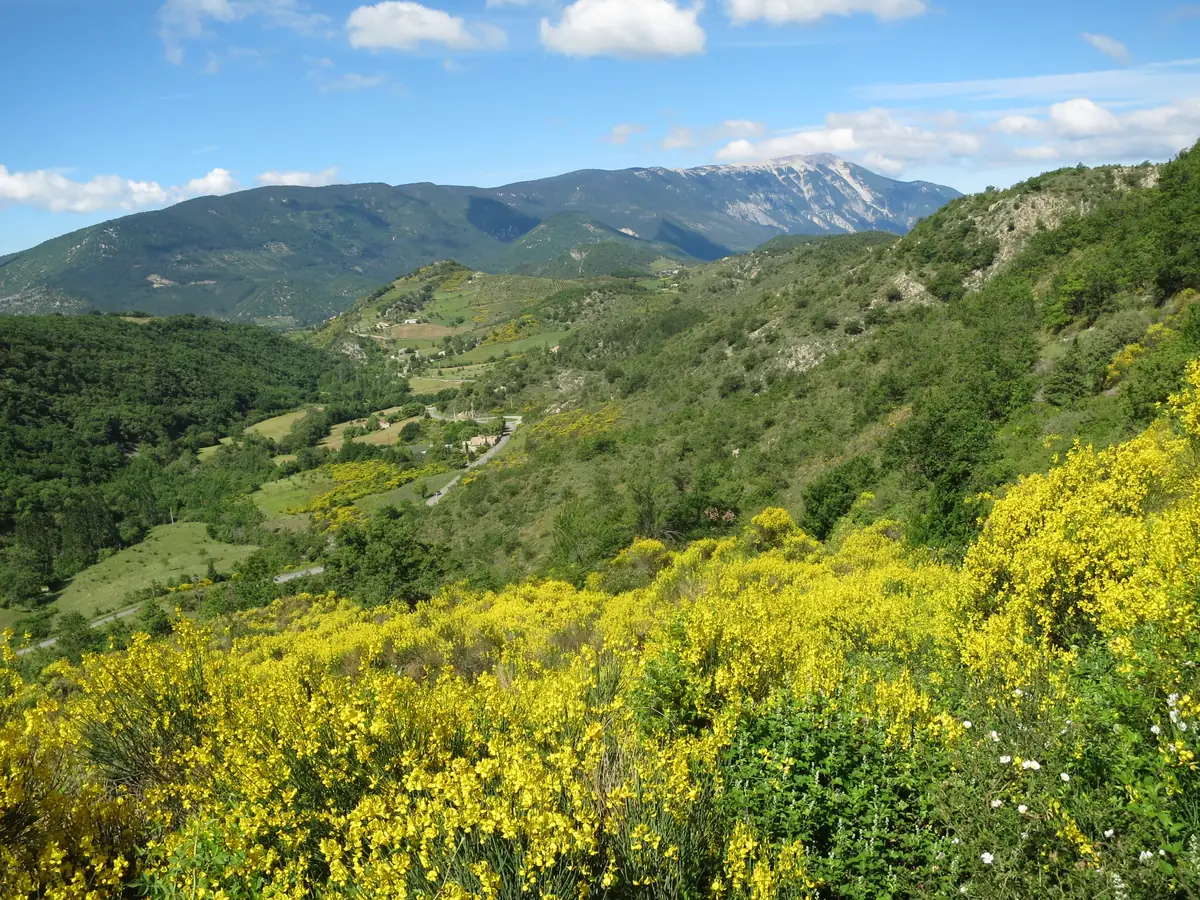
Following the Toulourenc valley westwards, Savoillans and then Brantes offer further stops facing the northern slopes of Ventoux. To the south, the roads through Aurel and Ferrassières lead to the lavender fields of Sault and the Albion plateau. The lavender fields of the Baronnies provençales provide more landscapes to explore in the Drôme.
Plan a separate outing to reach the summit of Mont Ventoux, visible from the countryside around Montbrun.
Practical information
Visiting Montbrun-les-Bains
- Route and duration
- Allow an hour and a half to two hours for the old village, fountains and photo stops. Add extra time for the spa quarter or a spa visit.
- Getting here and parking
- Montbrun is reached from Sault through Aurel, from the Toulourenc valley or from Séderon. The Promenade de l’Anary car park lets you leave the car before walking up into the old village.
- Fountains and heritage
- Ask the tourist office for the fountain trail map and details of guided visits. Check church opening arrangements locally. The Dupuy-Montbrun castle and Les Gipières are private properties.
- Baths and spa
- Check opening times, prices and access conditions for Montbrun’s Aqua-détente area. Booking arrangements for treatments and spa access depend on the option chosen.
- What to bring
- Comfortable shoes for the stone-paved lanes, steps and sloping streets, water and sun protection. In summer, choose the morning or late afternoon to explore the village.
To plan your visit: Baronnies en Drôme provençale tourist office.
Extend your stay
Guest houses to extend the getaway
These properties listed on the Portal are within 25 km as the crow flies of the location featured in this getaway. Visit their websites to plan your stay.

La Lauren
Charming vacation rental
Ferrassières
Visit website
Le Deffends de Redon
Charming bed and breakfast
Montbrun-les-bains
Visit website

Last updated: